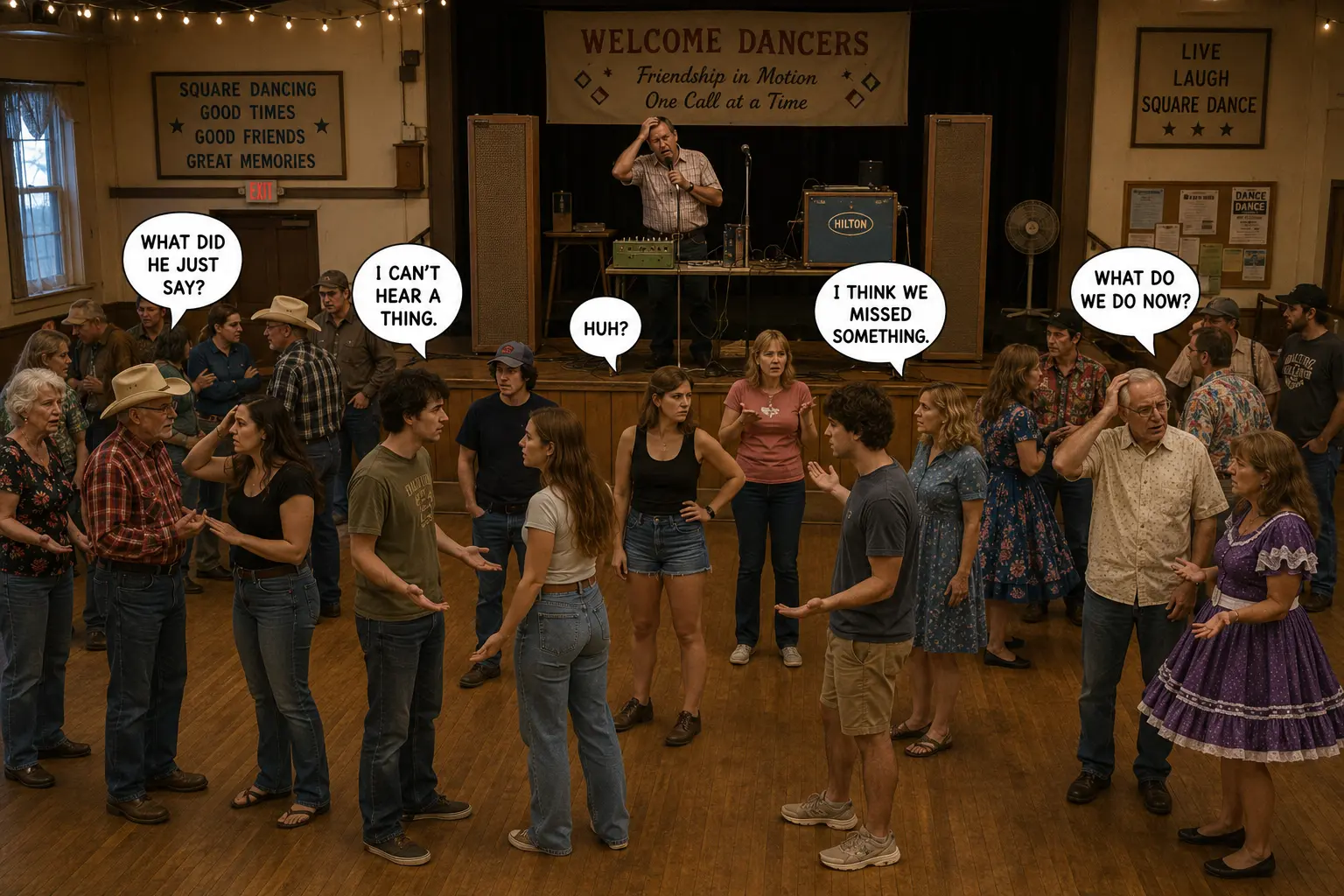
Every time the square dance community gathers to talk about the future of our activity, the conversation usually centers around the same ideas. We talk about recruiting younger dancers, improving our marketing, updating our image, simplifying lessons, or finding ways to make dances more exciting. Those are all good discussions, but I feel that we’re overlooking one of the most fundamental pieces of the puzzle.
PEOPLE MUST BE ABLE TO HEAR!
Not just hear that someone is talking, but clearly understand every word the caller says. Square dancing is unlike almost any other recreational activity because every dancer depends on real-time verbal instruction. If someone misses a call, it isn’t just their dance that’s affected, it can throw off an entire square. When that happens repeatedly throughout an evening, dancing becomes frustrating instead of enjoyable.
Jason Guinn, my lovely dance and life partner, is becoming fairly well known for being an audio enthusiast, some would probably say an audio snob, and I don’t think he would be too ashamed to claim that title. Through his influence, I’ve become a bit of one myself, too. But this shouldn’t be simply a matter of our personal preference or chasing the latest technology. There is real science behind good sound, and when it’s done properly, it transform the entire dancing experience.
One of the biggest misconceptions about audio is that louder is better. In reality, the opposite is often true. A poorly designed sound system usually compensates by turning the volume up until everyone is overwhelmed, yet people in different parts of the room are still struggling to understand the caller. That’s why you’ll often hear comments like, “It was so loud, but I still couldn’t understand the calls.”
Modern sound reinforcement doesn’t work that way. Today’s professional audio systems use digital signal processing, carefully placed loudspeakers, and sophisticated room analysis to create even coverage throughout the venue. Instead of blasting the front row while leaving the back of the room guessing, the system is tuned so that everyone hears essentially the same thing. The remarkable part is that because the sound is clearer, it often doesn’t have to be nearly as loud.
The difference is substantial. When dancers can effortlessly understand the caller, squares stay together longer, new dancers gain confidence more quickly, experienced dancers make fewer mistakes, and everyone finishes the evening feeling less mentally fatigued. Callers don’t have to strain their voices, musicians sounds better, and the overall atmosphere becomes more relaxed because people aren’t constantly fighting to hear or asking other dancers, “What was that call?”
This becomes even more important when we consider who our dancers are. Many members of our square dance community are at an age where some degree of hearing loss is simply a fact of life. If we’re serious about making our activity welcoming and enjoyable, then clear audio isn’t just a convenience, it is an accessibility issue. We shouldn’t expect dancers to work harder simply because our sound systems haven’t kept up with the times.
Unfortunately, many of the systems still commonly used in square dancing were considered modern decades ago. The world of live audio has changed dramatically since then. Churches, theaters, conferences, and concert venues routinely hire professional audio engineers whose entire job is to analyze a room, determine the best speaker placement, (which, by the way, isn’t always the front of the room…) tune the system using sophisticated measurement software, and ensure that every area receives clear, intelligible sound. They aren’t guessing or relying on trial and error. They’re applying acoustics, mathematics, and physics.
I’ve seen the benefits of this approach on a smaller scale. Since I’ve began teaching a few lessons using a modern column-array speaker system, Jason and I have had multiple dancers comment on how easy it is to understand me. The compliments are definitely not about my teaching (It’s still a work in progress…) nor the equipment. It’s about clarity. People simply enjoy dancing more when they don’t have to struggle to hear what comes next.
This experience has only reinforced something I’ve believed for a long time.
WE CAN DO BETTER!
We’re often willing to spend significant money on decorations, entertainment, facilities, and countless other aspects of a dance, yet the one thing every single dancer depends on, the ability to hear the caller clearly, is frequently treated as an afterthought.
Yes, bringing in a professional production company for a large event would cost money. But I think we’re asking the wrong question when we focus only on the price tag. The better question is this: What does poor audio cost us? How many dancers leave a convention mentally exhausted because they’ve spent an entire weekend working just to understand the calls? How many new dancers decide square dancing isn’t for them because they couldn’t follow what was happening? How many callers unknowingly spend their entire dance fighting against the sound system and its effects instead of simply calling?
If we’re serious about growing square dancing, then audio shouldn’t be an afterthought. It should be one of our highest priorities. Because no matter how talented the caller is, how wonderful the music sounds, or how beautiful the hall may be, none of it matters if the dancers can’t understand what’s being said.
After all, square dancing depends on one simple truth:
Well said! We have been thinking about the same issues in round dancing, particularly in large halls. We are exploring what might be feasible to do for improved sound for next year’s ICBDA convention in Montgomery.