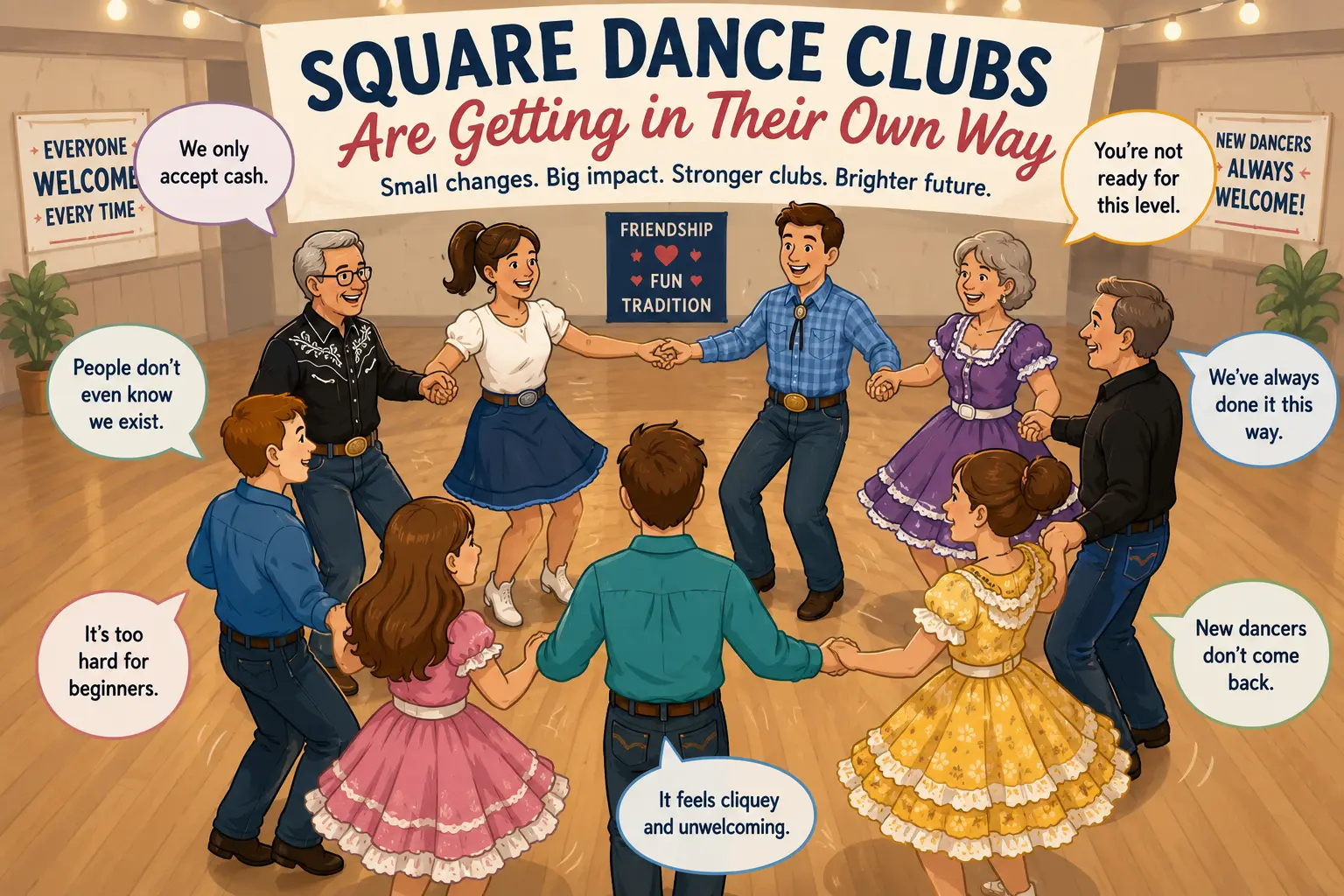
Square dance clubs don’t usually set out to sabotage themselves – but many are quietly following patterns that shrink their communities year after year. It’s rarely one big mistake. It’s a collection of small habits that feel “safe,” “traditional,” or “just how we do things,” but together they slowly make clubs less welcoming, less visible, and less sustainable.
The encouraging part is that the solution doesn’t require a reinvention. Most clubs don’t need new programs, major restructuring, or a break from tradition. What they need are small, repeatable adjustments that stack up over time. Think of it less like rebuilding the house and more like tightening the hinges, opening a few windows, and turning the lights on a little earlier.
One of the most common issues is the assumption that the club exists primarily for its current members, rather than for future ones. When a club becomes overly focused on internal comfort, it often unintentionally builds barriers for newcomers. Strict expectations about when someone is “ready,” who can attend what, or how quickly people must learn before being included can create a quiet message: you don’t belong here yet. That “yet” is doing a lot of damage. New dancers don’t stick around to wait for permission to feel included – they go where they are welcomed immediately.
A simple fix doesn’t require policy changes, just language shifts and mindset awareness. Instead of framing newcomers as “not ready,” clubs can reframe progression as layering: “Let’s get you comfortable here first, then we’ll add layers.” Same structure, different emotional impact. That small change alone can make learning feel like participation rather than evaluation.
Another self-inflicted wound is communication style. Many clubs still rely heavily on word-of-mouth, familiar circles, or outdated online presence. That worked decades ago, but it doesn’t match how people discover hobbies now. If someone has to already know a square dance club exists in order to find it, the club is effectively invisible to most of the population. Even when clubs do have websites or social media pages, they’re often missing basic information like beginner nights, cost, or what to expect. That uncertainty is enough to stop a curious person from ever showing up.
The fix here doesn’t require a marketing overhaul – just clarity and consistency. A simple, updated page or pinned post that answers three questions (“What is this?”, “What happens on a beginner night?”, and “What do I need to bring?”) removes a surprising amount of friction. One clear explanation is often more powerful than a dozen flyers scattered in the right places.
Inside the hall, onboarding friction is another quiet problem. Beginners can unintentionally be treated like long-term projects instead of potential future members. If a newcomer’s first night feels like a test – too much information, too little guidance, or the sense they’re in the way – they rarely come back. Square dancing is inherently social, but the learning environment can sometimes feel formal in ways that contradict that spirit.
Small cultural adjustments help more than structural ones. Assigning “soft anchors” – a few experienced dancers who naturally check in with newcomers – can completely change the experience without creating a formal program. A simple “You doing okay?” or “Stick with me this tip” turns confusion into connection. No committee required, just intentional awareness from people already on the floor.
Another subtle but important issue is how clubs handle inclusion during the learning curve. Beginners often feel like they are being evaluated, even when no one intends that. A helpful shift is celebrating participation over precision. When callers normalize mistakes “If you got lost, you’re in good company – that’s part of it” it lowers the pressure that quietly pushes people away.
Resistance to evolution also plays a role. Music choices, calling styles, dress expectations, and event formats can become frozen in time. Tradition matters, but rigidity turns tradition into a fence instead of a foundation. Many younger or first-time dancers aren’t rejecting square dance itself – they’re reacting to how inaccessible or unfamiliar the presentation feels. Even small adjustments in tone, pacing, or format can bridge that gap without changing the heart of the activity.
Visibility is another area where incremental change matters. Clubs don’t need viral marketing or expensive campaigns. They need consistency. A weekly post, a few photos with context, or short clips showing what a night actually looks like can slowly reshape perception. People rarely join something they can’t imagine themselves in, and imagination comes from exposure, not perfection.
Another small but increasingly important friction point is how clubs handle money. Many square dance clubs still operate as cash-only environments, which can feel like a minor detail to longtime members but a real barrier for newcomers. In a world where people rarely carry cash at all, requiring exact change or a folded bill in your pocket adds an unnecessary step to participation. It’s not that people won’t pay – it’s that they didn’t plan for a cash-only system in an otherwise modern social activity. Offering simple digital payment options like card readers or mobile payment services doesn’t change the spirit of the club, but it does remove one more reason someone might hesitate before coming back. The easier it is to say “yes” in the moment, the more likely that yes becomes a habit.
Finally, first impressions carry more weight than most clubs realize. A newcomer doesn’t evaluate a club based on history or potential – they evaluate it based on one evening. If that experience feels confusing, distant, or overly formal, no amount of future improvement matters. That first night either opens the door or quietly closes it.
The hopeful reality is that none of this requires synchronized change. In fact, trying to fix everything at once usually creates resistance. But when small shifts happen consistently – a clearer invitation here, a warmer greeting there, a more visible online presence, a gentler tone during learning – the culture changes without anyone declaring a revolution.
Square dance itself isn’t struggling because the activity is outdated. In many ways, it’s timeless. The real challenge is whether clubs can stop unintentionally making it harder than it needs to be for new people to join the circle – and instead make the entry point feel like an open door that’s already been held for them.
Very well written and very well said. One thing I would add is that younger dancers (14-25 years) get really sick and tired of old folks (regular dancers in thier 60s-80s) coming up to them all the time and saying things like, “it is so good to see young people joining square dancing and then making a great big fuss over then and over the microphone too. It turns them off and turns them right back out the door.
The are potential new dancers just like that over 60s couple that came in for their first night but no one fussed over them being young. It gets worse with kids and even more so at festivals and conventions if they did stick around long enough to finish classes.
I think that’s a very valid observation. I spent about 10 years being “the young dancer” in the room, and while I always appreciated that people were excited to see younger dancers, it could become exhausting. A warm welcome is one thing, but constantly being singled out because of your age can make you feel like a novelty instead of part of the group.
I’ve noticed the same thing with comments about dance level. People often compare what they see on the floor to age, but age isn’t really the relevant factor. I’ve been dancing for 13 years. Most dancers want to be seen for their experience, interests, and participation in the activity – not as “the young one.” Whether someone is 16 or 96, they usually just want to be treated like any other dancer.